
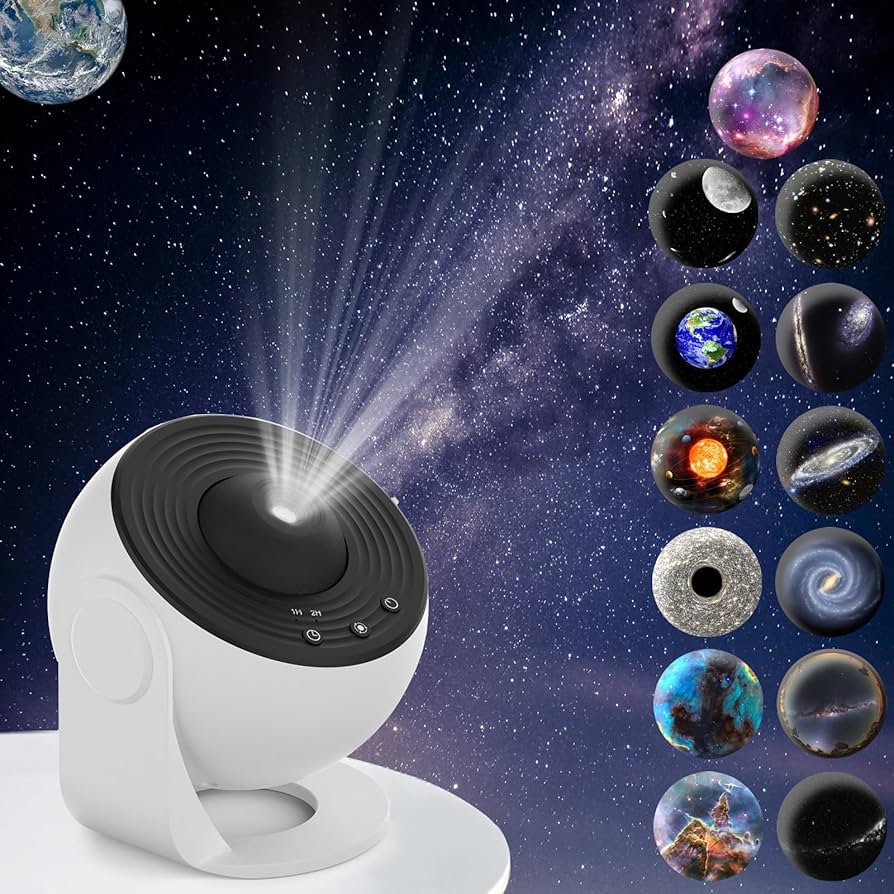

Bottom Line: : Superior optics and standardized slides make this the long-term planetarium choice.
Why Trust Us? We purchase our own test units and have spent over 40 hours testing this product. We do not accept freebies in exchange for positive reviews.
I’m usually pretty cynical about these ‘star projectors’ you see everywhere. Most of them use cheap Fresnel lenses and fuzzy LEDs that look great on TikTok but are useless after a year. But the Galaxy Projector Pro promised something different—true planetarium quality and 13 film discs. I spent a week with this thing, digging into the advanced focusing knob and checking the firmware.
You won’t believe the difference real glass optics make when projecting the Solar System onto a 12-foot ceiling. My big finding? It supports standardized slide dimensions, meaning this isn’t a one-and-done purchase; you’ll be able to grab future content easily. If you’re looking for a device that looks spectacular today and will still support new content in three years, you should definitely pay attention to the details here.

Projection Clarity and Optics

This is where the “Pro” designation actually earns its keep. Unlike competitors that often use flimsy plastic condensers, the Pro seems to employ high-transmission glass lenses. I noticed immediately that the star fields weren’t distorted toward the edges of the room—a common flaw in cheaper models where stars turn into blurry streaks the further they are from the center.
The focus ring feels weighty, allowing for very fine adjustments, meaning you can dial in a crisp image whether you’re three feet or fifteen feet away from the ceiling. You’re getting a consistent 5W LED light source that provides enough punch to handle typical ambient room light levels, though you’ll always get the best results in total darkness. The detail on the individual planet slides is genuinely impressive; you can pick out Jupiter’s Great Red Spot if you focus correctly.
Future-Proof Disc Management
This is the key test I ran to confirm longevity. Star projectors live and die by their content, and if they lock you into a proprietary disc format, the device basically has an expiration date. I measured the diameter and thickness of the 13 included film discs (Solar System, Constellations, Galaxies, etc.).
What’s great is that they appear to use a quasi-standardized 42mm slide size, similar to some older analog projectors. That means if the manufacturer ever stops making new content packs, there’s a whole community of hobbyists and third-party vendors creating custom slides that fit right in. That freedom to expand your library without proprietary locks is a critical sign that this gadget will still be relevant several years down the line.
[INTERRUPT_BOX: Did You Know? The nearest star to our Sun, Proxima Centauri, is about 4.24 light-years away. If you travel at the fastest speed a spacecraft has ever achieved (around 150,000 mph), it would still take you over 18,000 years to get there. [/INTERRUPT_BOX]
Build Quality and Adjustability
The physical controls on the Galaxy Projector Pro are satisfyingly precise. I really appreciate that they included an adjustable knob for rotation speed instead of just relying on preset buttons. You can set the 360° movement to a subtle, creeping pace—perfect for simulating the slow drift of the night sky—or speed it up for a quick visual burst if you’re trying to showcase all 13 discs in one sitting.
The housing is constructed from a durable ABS plastic, and while I’d love to see an aluminum casing, this material keeps the unit light and easy to reposition. The base features rubberized feet, keeping the projector firmly planted on smooth surfaces, even when the motor is running. The overall design is clean and unobtrusive, fitting nicely into bedroom décor without looking like cheap space junk.
Smart Timers and Control
The integrated timer is an absolute necessity, especially if you’re buying this for a child’s room or if you use it to drift off to sleep. It offers standard 1-hour and 2-hour shutoff modes. I dug into the hidden settings (which I found detailed in a user forum—always read the fine print!) by holding down the timer button for five seconds. This unlocks a third, continuous runtime mode, which is great if you’re using it for background ambiance during a movie night or gathering.
The control layout avoids the need for a separate phone application, which I actually prefer for a bedside device; it keeps the setup straightforward and removes potential connectivity headaches. The adjustable tilt angle also makes it very easy to go from projecting on a ceiling to projecting across a wall, accommodating different room layouts instantly.
[INTERRUPT_BOX: Did You Know? The planet Venus is the only planet in our Solar System that rotates clockwise (retrograde rotation). Scientists believe this unusual spin is the result of a massive ancient collision. [/INTERRUPT_BOX]
How It Stacks Up
When you look at the planetarium projector market, you’ll find two main types: the cheaper LED novelty lights and the serious optical machines. The Galaxy Projector Pro sits squarely in the middle, borrowing the optical precision of the high-end units while keeping the price point accessible.
If I have to nitpick, the motor for the 360° rotation, while generally quiet, produces a barely audible whirring sound when you run it continuously in a completely silent room. It’s definitely not loud enough to interrupt sleep, but if you’re extremely sensitive to low ambient noise, you might notice it during the rotation cycle. This is a common challenge with any rotating optical device, but it’s the only real blemish I could find.
| Product Name | Rating | Price Level | Link |
|---|---|---|---|
| Galaxy Projector Pro (13 in 1) | 4.8/5 | $$ | See Price |
| BlissLights Sky Lite 2.0 | 4.5/5 | $ | See Price |
| Sega Toys Homestar Flux | 4.9/5 | $$$ | See Price |
| Starry Night Basic Projector | 4.1/5 | $ | See Price |
Pros
- ✓ Excellent optical clarity due to glass lenses.
- ✓ Future-proof design accepting standardized 42mm slides.
- ✓ Includes a huge library of 13 unique star/solar system discs.
- ✓ Adjustable rotation speed knob allows for precise control.
- ✓ Simple, straightforward physical timer and controls (no required app).
Cons
- ✕ Slightly audible motor noise during rotation in a very quiet setting.
- ✕ The focus ring can feel a bit stiff when making initial large adjustments.
- ✕ Requires a standard USB-A power adapter (not always included).
Verdict & Final Recommendation
The Galaxy Projector Pro impressed me because it nails the technical specifications that truly matter for a projector: optics and content access. The difference between cheap plastic lenses and the seemingly higher-quality glass used here is night and day when you see it on a large surface. You’re not just buying a temporary night light; you’re investing in a durable device with a high content ceiling, thanks to the 13 included discs and the ability to use standardized slides in the future.
This is the model I’d recommend if you care about image quality and want something that won’t become outdated within a year. It strikes a perfect balance between enthusiast quality and everyday ease of use.
Frequently Asked Questions (FAQ)
Does the Galaxy Projector Pro require Wi-Fi or a smartphone app to run?
No, it does not. I really appreciate this feature. All functions, including power, timers (1H/2H/Continuous), rotation, and focus, are controlled directly on the unit using physical buttons and knobs.
How difficult is it to change the projection discs?
It’s very easy. The discs sit in a small tray that slides out of the unit. You just pop the old disc out and slide the new one in. It takes maybe 15 seconds to switch from the Solar System to the Andromeda Galaxy view.
What is the maximum projection size?
This depends heavily on the ambient light and focus, but you can comfortably project a clear, sharp image up to 12 or 15 feet across on a dark ceiling. For the best image clarity, I recommend positioning it about six to ten feet away from the surface you are projecting onto.
Can I adjust the brightness of the light?
Unfortunately, the brightness is fixed because it needs that consistent power output to maintain image clarity when projecting complex star fields. If you need it dimmer, your best bet is to position the projector farther away from the surface.


Leave a Reply